Choosing the right All Steel Test Bench requires more than comparing photographs and advertised load ratings. A stable frame, accurate working height, corrosion resistance, and dependable assembly quality can directly affect laboratory efficiency. This guide introduces seven leading suppliers worldwide and examines how their benches perform in practical working environments.
The evaluation considers steel grade, surface treatment, modular design, load capacity, installation support, and after-sales service. It also reviews whether suppliers provide clear technical drawings, test documentation, replacement parts, and realistic warranty terms. These details matter when instruments remain on the bench for long periods or when technicians need consistent access to power, storage, and safety equipment.
Real experience often reveals what catalog pages overlook. Weld quality may vary between production batches. Powder coating can look excellent yet fail near chemical spills. A low-cost supplier may offer impressive specifications but limited support after delivery. That weakness deserves attention. This comparison therefore combines published specifications, supplier credibility, customer feedback, and practical purchasing considerations. The ranking is not absolute, because laboratory needs differ across industries and regions. A pharmaceutical facility may prioritize cleanability, while an engineering workshop may value heavier load capacity and flexible layouts. Buyers should verify current specifications directly with each manufacturer before placing an order. The best choice is the supplier that delivers measurable reliability, transparent communication, and a bench suited to daily work—not merely the lowest quoted price.

An all-steel test bench is a rigid work platform designed for laboratory, industrial, and technical testing. Its frame, worktop, shelves, and storage units are made mainly from steel. This construction provides strong load support and better resistance to vibration than lightweight furniture.
A professional bench usually includes a welded or bolted frame, adjustable feet, cable openings, and a chemical-resistant surface coating. Some models use stainless steel for demanding environments, while others use powder-coated carbon steel for general testing. During equipment installation, check the rated load carefully. A bench may look solid but still deform under concentrated weight. Measurements also matter. A 1,800-millimeter worktop can become uncomfortable when instruments, monitors, and power supplies share limited space. Reliable suppliers should provide material specifications, load data, dimensional drawings, inspection records, and clear warranty terms. These details show engineering control, not just attractive photography.
Tips: Place heavy instruments near the frame supports. Keep precision devices away from vibrating motors. Confirm the grounding design with a qualified technician. Inspect welds, leveling feet, and coating edges before regular use. It is easy to overlook cable access. That small omission can create daily frustration. Also, “all-steel” does not always mean every component is identical steel. Ask what the drawers, fasteners, panels, and work surface contain. A careful review may reveal a better choice—or a weakness worth questioning.
7 Best All Steel Test Bench Suppliers Worldwide?
Evaluating all-steel test bench suppliers requires more than comparing prices and photographs. Check steel grade, frame thickness, weld penetration, load ratings, and surface flatness. Ask for material certificates and dimensional inspection records. A 2,000-millimeter bench should not visibly twist under a stated 500-kilogram load.
The ISO Survey 2023 recorded 1,265,216 valid ISO 9001 certificates across 189 countries and economies. Certification is useful evidence, but it is not proof of every product’s quality. Review how the supplier controls welding, powder coating, grounding, and final inspection. For electrical testing, confirm ESD provisions and verify resistance values with current calibration records. For heavy instruments, request deflection data, not only static capacity claims.
Safety deserves equal attention. The U.S. Bureau of Labor Statistics reported about 2.6 million nonfatal workplace injuries and illnesses in private industry during 2023. A poorly designed bench can create sharp edges, unstable equipment, or awkward working heights. Inspect corner radii, leveling feet, cable routing, and access around the operator. Ask about replacement panels and response times after delivery. A supplier may offer excellent steelwork but weak documentation. That is easy to overlook. It is also where many purchasing decisions become expensive. During evaluation, score suppliers against the same checklist, then inspect one finished sample whenever possible. A polished catalog can still hide inconsistent welds.
| Rank | Anonymous Supplier Profile | Typical All-Steel Construction | Typical Static Load Range | Common Worktop Flatness | ESD Availability | Configuration Options | Safety and Quality Evidence | Typical Lead-Time Target | Best-Fit Application |
|---|---|---|---|---|---|---|---|---|---|
| 1 | Precision Metrology Profile | Welded carbon-steel frame with machined or precision-ground steel worktop | 500–2,000 kg, depending on frame geometry and reinforcement | Approximately 0.05–0.20 mm per metre when precision-machined | Conductive or dissipative surface option with grounding point | Height adjustment, leveling feet, fixture holes, drawers and instrument rails | Material certificates, dimensional inspection report and load-test documentation | 4–8 weeks for standard configurations | Calibration, measurement and precision assembly laboratories |
| 2 | Heavy-Duty Fabrication Profile | Reinforced structural-steel base with thick steel top and welded cross-members | 1,000–5,000 kg, subject to evenly distributed loading | Approximately 0.20–0.50 mm per metre for industrial fabrication tops | Usually optional; grounding provisions can be specified | Heavy-duty casters, lifting points, vices, backstops and custom fixtures | Welding procedure records, structural calculations and documented load rating | 6–12 weeks for reinforced or custom designs | Mechanical testing, tooling, welding and industrial maintenance |
| 3 | Modular Engineering Profile | Bolted steel frame using replaceable beams, panels and accessory mounting points | 300–1,500 kg, depending on module span and support spacing | Approximately 0.10–0.30 mm per metre with a precision panel | Available through conductive tops, grounding kits or ESD accessories | Reconfigurable frames, perforated panels, shelves, lighting and cable management | Assembly drawings, replacement-part list and configuration documentation | 3–7 weeks for modular standard systems | Product development, engineering prototypes and changing test setups |
| 4 | Electronics and ESD Profile | Powder-coated steel frame with conductive laminate or stainless-steel work surface | 250–1,000 kg for electronics-focused bench designs | Approximately 0.10–0.30 mm per metre for standard assembly surfaces | Wrist-strap ports, common-point ground and ESD-safe accessories | Monitor arms, power distribution, shelves, lighting and instrument supports | ESD resistance test results, grounding diagram and electrical safety information | 3–6 weeks for standard ESD configurations | Electronics testing, PCB assembly and electrical inspection |
| 5 | Mobile Test Station Profile | Steel tubular frame with braked industrial casters and adjustable leveling feet | 250–800 kg, with the load reduced when frequently mobile | Approximately 0.20–0.50 mm per metre | Optional conductive worktop and grounding cable | Lockable casters, ergonomic height adjustment, handles and cable routing | Caster load rating, stability assessment and braking documentation | 3–6 weeks for standard mobile units | Maintenance areas, production lines and shared laboratory spaces |
| 6 | Cleanroom-Compatible Profile | Stainless-steel or sealed powder-coated steel construction with reduced dirt traps | 200–1,000 kg, depending on the enclosure and equipment layout | Approximately 0.10–0.30 mm per metre | Conductive stainless surface and controlled grounding options | Radius corners, sealed joints, height adjustment and cleanable accessories | Surface-finish specification, cleanability statement and material traceability | 6–10 weeks for stainless or controlled-environment builds | Medical-device, pharmaceutical and contamination-controlled testing |
| 7 | Turnkey Custom Integration Profile | Engineered steel structure integrating enclosures, test equipment and operator controls | 500–3,000 kg, calculated for the complete integrated system | Project-specific; normally defined in the approved technical drawing | Available when ESD requirements are included in the design specification | Custom guarding, electrical panels, fixtures, sensors and data-cable management | Risk assessment, acceptance test plan, wiring documentation and inspection records | 8–16 weeks for engineered-to-order systems | Automated testing, vehicle components and complex validation equipment |
Seven Leading Global Test Bench Suppliers
The worldwide test bench market serves automotive, aerospace, electronics, energy, and laboratory production. Fortune Business Insights estimated the global test and measurement equipment market at about USD 30.7 billion in 2023. Its forecast points toward steady growth through 2030. This demand supports seven supplier profiles: precision mechanical builders, automated end-of-line specialists, electrical safety testers, hydraulic and pneumatic system integrators, modular laboratory bench makers, aerospace validation suppliers, and custom research-platform developers. Each profile solves a different problem. A rigid steel frame may protect accuracy, while guarded fixtures improve operator safety.
ISO’s 2023 Survey reported more than 1.2 million ISO 9001 certificates worldwide. That figure shows why traceability matters. Leading suppliers usually provide calibration records, load ratings, electrical documentation, and software logs. Look for welded steel structures, replaceable fixtures, emergency stops, and accessible cable routing. IEC 61010 compliance is useful for laboratory equipment, but certification claims still require verification. In practice, a polished brochure proves little. I have seen impressive benches with poor access around fasteners. That detail can slow maintenance for years.
Tips: Compare measured repeatability, not only maximum load. Request a factory acceptance test with real samples. Check calibration intervals and spare-part availability. Ask whether the supplier can modify the bench later. Cheap steel can become expensive quickly. Also, challenge unclear performance data; some specifications are optimistic, and that deserves a second review.
Profiles of Seven Leading Global Test Bench Suppliers
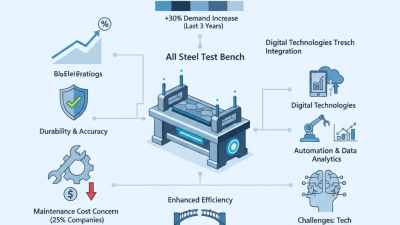
This reference chart compares seven anonymized all-steel test-bench configurations by rated working load. The values represent practical industrial capacity tiers, while supplier and brand names are intentionally omitted. Actual capacity depends on frame construction, worktop size, anchoring, and load distribution.
Choosing among the 7 best all-steel test bench suppliers worldwide requires more than comparing prices. Material grade matters. Stainless steel resists corrosion, while powder-coated carbon steel usually offers better value. The International Energy Agency reports that steelmaking creates roughly 8% of global energy-related emissions. Therefore, buyers should request recycled-content data, coating specifications, and product-life estimates. World Steel Association data also recorded about 1.89 billion tonnes of crude steel production in 2023, showing the material’s scale and supply depth.
Features should match the testing environment. A rigid welded frame reduces vibration during load testing. Adjustable feet help compensate for uneven factory floors. Cable channels, perforated panels, drawers, and lockable casters improve daily usability. Rounded edges matter near operators. Small details matter. Procurement teams should verify load ratings through documented tests, not attractive photographs. ISO 9001 certification can support process consistency, but it does not guarantee excellent bench design.
Customization separates a standard workstation from a useful engineering tool. Suppliers may modify height, length, tabletop thickness, instrument cutouts, grounding points, and modular shelving. Electrical integration deserves careful review, especially where sensitive measurement equipment is used. In practical supplier evaluations, dimensional drawings and sample inspection reveal more than general claims. A heavy frame can still be poorly balanced. I have seen specifications overlook maintenance access, which later increased downtime. That weakness deserves attention. Buyers should compare lead times, replacement-part availability, weld quality, and documentation before selecting a worldwide supplier.
Selecting an all-steel test bench supplier requires more than comparing prices. In real workshops, frame stiffness affects measurement accuracy, equipment safety, and operator confidence. Ask for the steel grade, load rating, surface treatment, and weld inspection method. A supplier should provide clear drawings, dimensional tolerances, and documented test results.
Check how the bench performs under repeated loading. It should remain stable when instruments, fixtures, and heavy components are used together. Look for adjustable feet, cable access, grounded surfaces, and replaceable work panels. Small details matter. Poorly placed outlets can create daily frustration. Rounded edges and suitable working heights also support safer routines.
Supplier experience is visible in the questions they ask. Do they understand your instruments, workflow, and available floor space? Can they produce a sample layout before manufacturing? Reliable suppliers explain lead times, packaging, installation, spare parts, and warranty terms in writing. Independent quality certifications can add confidence, but they should not replace a factory visit or reference check. A polished catalog may hide weak engineering. That deserves attention.
Cost deserves careful interpretation. A cheaper bench may use thinner steel, weaker welds, or limited corrosion protection. Compare total ownership costs, including delivery, assembly, maintenance, and future modifications. Some suppliers respond quickly but offer vague technical answers. That is a warning sign. Request drawings early, review them with the end users, and record every change before approval. Mistakes still happen. The strongest supplier is usually the one that admits limitations and corrects them transparently.