Leave Your Message

7 Best Acid-Base Cabinets for Global Buyers?

Choosing the right Acid-Base Cabinet is a safety decision, not merely a storage upgrade. Global laboratories face different chemical inventories, room layouts, climate conditions, and compliance requirements. A cabinet that performs well in Singapore may not suit a facility in Germany, Brazil, or Canada.

This guide compares seven practical options for international buyers. It examines corrosion resistance, separate acid and base compartments, adjustable shelving, spill containment, ventilation compatibility, locking systems, and load capacity. It also considers documentation, replacement parts, warranty support, and regional certification. Small details matter. A leaking bottle, a warped shelf, or a blocked vent can create serious operational problems.

Dr. James A. Kaufman, founder of the Laboratory Safety Institute, stated, “Safety is not a priority; it is a value.” His principle fits chemical storage closely. Buyers should verify cabinet materials against their actual chemicals, rather than trusting broad product labels. They should also consult trained safety professionals and local regulations before installation. This guide cannot replace a site-specific risk assessment. That limitation matters.

Some products may appear similar online, yet their hinges, coatings, seals, and trays can differ significantly. Price alone gives an incomplete picture. A lower-cost cabinet may demand earlier repairs or offer weaker technical support. The best choice balances protection, usability, verified performance, and long-term service. These seven Acid-Base Cabinet options provide a useful starting point, though careful review remains essential.
7 Best Acid-Base Cabinets for Global Buyers?

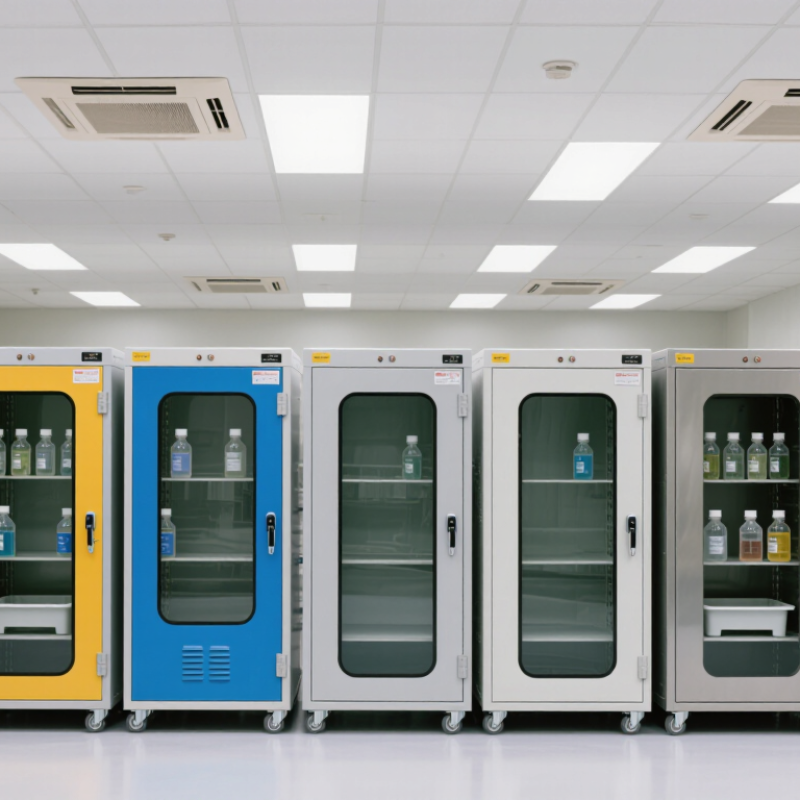
Seven Acid-Base Cabinet Types Ranked Under NFPA 30 and OSHA 1910.106

Seven Acid-Base Cabinet Types Ranked Under NFPA 30 and OSHA 1910.106

For global buyers, cabinet selection should begin with chemical behavior, not appearance. NFPA 30 and OSHA 1910.106 mainly address flammable liquids, while acids and bases also require corrosive-storage controls. The ranking below reflects practical risk reduction, construction, access, and workplace inspection needs. It is not an official standards ranking.

Cabinet Types Ranked by Practical Risk Reduction

  1. Double-wall steel flammable-liquid cabinet: best for solvents with ignition risks. Look for listed capacity, self-closing doors, and a raised leak-retention sill.
  2. Fire-resistant vertical cabinet: suitable for larger quantities and clear floor placement. Keep it away from exits and heat sources.
  3. Self-closing undercounter cabinet: useful near workstations, but only when daily quantities remain limited.
  4. Polyethylene corrosive cabinet: a strong choice for many acids and bases because it resists rust and chemical attack. Never store incompatible substances together.
  5. Acid cabinet with separate trays: supports segregation and makes leaks easier to identify.
  6. Base cabinet with adjustable shelves: helpful for heavy containers, provided shelves can carry the load without bending.
  7. Ventilated corrosive cabinet: appropriate only after a competent safety review confirms that ventilation will not spread hazardous vapors.

In practice, the best cabinet has labels facing outward, intact containers, and enough empty space for inspection. Separate acids from bases, oxidizers, and flammable liquids. NFPA 30 features should not be treated as proof of chemical compatibility.

OSHA requirements also depend on container type, quantity, fire protection, and workplace conditions. Standards change, and local authorities may interpret them differently. A small oversight remains possible: cabinet selection alone cannot correct poor inventory control or untrained handling.

Acid Cabinets: Polyethylene Compatibility Tested by ASTM D543

7 Best Acid-Base Cabinets for Global Buyers?

For global buyers, the best acid-base cabinets begin with material evidence, not attractive finishes. High-density polyethylene offers useful resistance to many acids and bases, but compatibility depends on concentration, temperature, exposure time, and mechanical stress. ASTM D543 provides a recognized method for evaluating plastics against chemical reagents. It can include immersion testing, visual inspection, and changes in weight, strength, or appearance.

A careful buyer should request polyethylene test data for the actual chemical conditions. Look for details such as reagent concentration, test temperature, exposure duration, and specimen thickness. A cabinet that performs well in a short room-temperature test may behave differently beside warm containers. Check the hinges, shelves, seals, and fasteners too. The plastic body is only one part of the system.

In practical inspections, small changes matter. Whitening, swelling, soft spots, or fine cracks deserve attention. A strong cabinet should also support stable shelving and controlled spill containment. Ventilation requirements may vary by chemical and facility design, so technical advice is valuable before installation. ASTM D543 does not guarantee universal chemical resistance. That limitation matters. Some test reports are incomplete, and buyers should question missing conditions rather than assume safety. The best choice combines verified polyethylene compatibility, clear documentation, practical access, and a design suited to daily handling.

This screening chart summarizes the typical chemical resistance of polyethylene to commonly stored acids on a qualitative 1–5 scale, where 5 indicates excellent resistance under ordinary ambient conditions. Actual cabinet selection should be verified for acid concentration, temperature, exposure time, stress cracking, and the specific ASTM D543 test conditions.

Base Cabinets: Corrosion Resistance and Chemical Segregation Requirements

7 Best Acid-Base Cabinets for Global Buyers?

Base cabinets should be selected for chemical behavior, not appearance. Acids and bases require separate storage because leaks can react violently, generate heat, or release harmful vapors. Corrosion resistance is essential. Polyethylene liners, chemically resistant coatings, and non-metallic shelf supports can reduce damage from small spills. Yet “corrosion-resistant” is not universal. Concentration, temperature, and storage time still matter.

The U.S. EPA’s 2022 TRI National Analysis reported about 29.3 billion pounds of production-related chemical waste managed by reporting facilities. This figure covers many substances, not cabinet failures. However, it shows why containment and segregation deserve measurable attention. NFPA 400 recommends separating incompatible hazardous materials, while OSHA 29 CFR 1910.1450 requires laboratories to control chemical storage risks. Buyers should request compatibility charts, load ratings, spill-retention capacity, and test documentation.

Look beyond the door seal.

A practical cabinet should keep acids away from bases, oxidizing acids away from organic materials, and incompatible containers on separate secondary trays. Adjustable shelves help, but shelf clips may corrode before the cabinet body. That detail is easy to miss. Vent connections also need review, since unnecessary ventilation can spread corrosive vapors. Local regulations may require different fire, ventilation, labeling, or seismic features. A cabinet meeting one country’s specification may not satisfy another market’s inspection requirements.

Fire-Safety Ratings: EN 14470-1 Classes from 15 to 90 Minutes

Choosing among the seven best acid-base cabinets requires more than checking capacity or door style. Fire resistance deserves priority. EN 14470-1 classifies cabinets by tested fire endurance: 15, 30, 60, or 90 minutes. These ratings describe how long the cabinet can limit internal temperature rise during a standardized external fire test. They do not promise complete protection.

A 15-minute cabinet may suit lower-risk storage areas with rapid emergency access. Class 30 offers a wider response window. Classes 60 and 90 are more appropriate where evacuation routes, valuable equipment, or larger chemical inventories demand extra delay. NFPA 30, the Flammable and Combustible Liquids Code, also emphasizes controlled storage, separation, ventilation, and spill management. Cabinet certification cannot replace those measures.

The scale of fire risk remains significant. NFPA’s 2023 U.S. Fire Loss report recorded about 1.39 million fires and approximately 3,670 civilian fire deaths. That data does not isolate laboratory cabinets, but it shows why passive fire protection deserves attention. In practice, verify the EN 14470-1 test certificate, installation conditions, shelf loading, and door-closing performance. Acid and base compatibility still matters, even inside a fire-rated cabinet. Never assume one cabinet safely handles every chemical group.

A higher rating is not automatically better. It may increase weight, cost, and ventilation demands. I have seen buyers focus on “90 minutes” while overlooking corrosion resistance and segregation. That is an expensive blind spot. Select the rating after reviewing the chemical inventory, room layout, emergency plan, and local authority requirements.

Global Buyer Scorecard: Capacity, Ventilation, UN Labels, and ISO 3864

7 Best Acid-Base Cabinets for Global Buyers?

A global buyer scorecard should measure usable capacity, not advertised volume. Record internal shelf dimensions, load ratings, and the number of compatible containers. A 100-litre cabinet may hold less after corrosion-resistant trays and spill clearance. That detail matters.

Ventilation needs careful judgment. The 2023 ACS Safety in Academic Chemistry Laboratories guidance emphasizes compatibility, segregation, and controlled storage rather than automatic ducting. Exhaust connections can spread corrosive vapors if poorly designed. They can also weaken cabinet containment. Request airflow data, pressure readings, and a documented risk assessment. Do not assume “vented” means safer. It may not.

Labels require equal scrutiny. The UN Recommendations on the Transport of Dangerous Goods, Model Regulations, and GHS Revision 10 define hazard communication principles for packages and chemicals. Match cabinet signage with local requirements, then check pictogram proportions and colors against ISO 3864-1. UN labels belong on regulated packages, not as decoration on a cabinet door.

Capacity, ventilation, and labels should be scored separately. A practical audit can use three ratings: verified, conditionally acceptable, and unverified.

That last category is useful. Supplier claims, translated manuals, and missing test records often deserve a second look. A cabinet that looks excellent may still fail a compatibility review.